How Many Gouldian Finches Fit in a Cage?
My Way of Measuring
There’s an old “rule” about fitting birds into cages, and it basically says that height doesn’t matter. In other words if a cage is 2 feet by 2 feet, it could be a skyscraper and it would hold the same number of birds.
Affiliate Statement: This website participates in the Amazon Affiliate Program and others. Your purchase through the product links may earn us a small commission. This will be donated to a 501(c)3 bird rescue organization – so thank you!
Now to some degree that’s true – especially if the width of your cage is 20-23”. I mean, finches are not helicopters. They can’t beam themselves straight up and down. But with a wider cage – say this one that’s 37” wide – there’s got to be a little bit more room for birds right? (I mean, they’re 5 inches long. Just sayin’)
Prevue F050 Large Flight Cage for Finches
So I did a very un-scientific experiment a few years ago. I’d had my birds a really long time and knew them well. I had 2 of these cages zip-tied together to make a 74” long flight. It contained 8 birds, or 4 pairs. I went by the “standard” (wonder who made it so?) using the square-feet rule.
Here’s the math. For ease of the discussion, I’m going to round the numbers:
Length 74”, let’s round down and call it 6 feet.
Depth, 23” call that 2 feet.
Height, 47” roughly 4 feet.
Using the standard rule of thumb, multiply length times depth. 6×2=12 square feet; One pair needs 3 to 4 square feet, so the cage will hold up to 4 pairs. I was already overcrowded, according to the math.
6X2 = 12 square feet = 4 pairs?
But my birds were happy. They weren’t fighting or feeling overcrowded. I myself struggled to even find them in there, due to them having plenty of space. So I wondered – how many pairs can I really put in there without it being too crowded?
Now this is tricky, because to get to the highest amount you have to stress your birds a little by overcrowding them. I slowly added one pair and another. Let’s introduce cubic feet, by multiplying LxDxH.
6x2x4 = 48 cubic feet.
48 cubic feet/ 6 = 8 cubic feet per pair (note that’s pair, not single bird).
6X2X4=48 = 7 pairs?
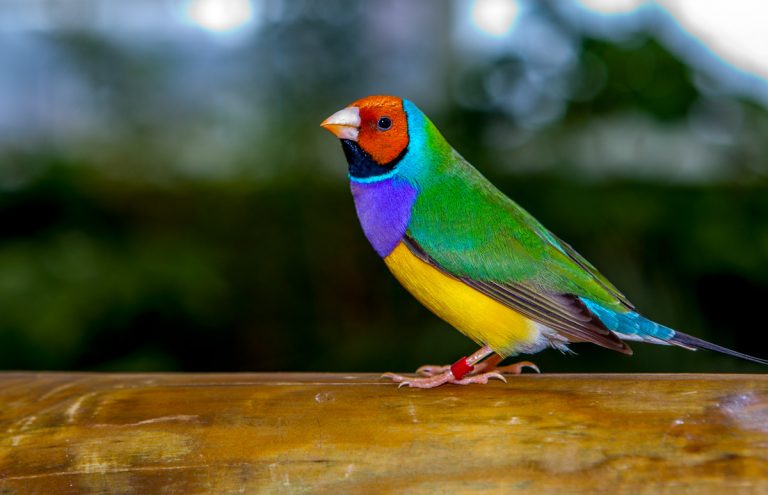
When I had 6 pairs, or 12 individuals in the cage, a red-headed yellow-backed male decided he owned 75% of the cage. Things got stressful.
Here he is, looking cute and innocent:
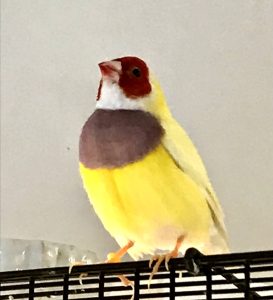
I was able to calm him down somewhat by adding LOTS of fake greenery to block his view of the so-called intruders (who had already been residents, long before him). Little rascal.
Next, I asked a bunch of breeder friends: how many birds would you keep in this cage? Their answers varied from 20 up to 60.
So much for math.
I won’t be putting 60 birds in these cages anytime soon!
Eventually, I removed the yellow-backed male and his favorite hen, putting them in their own breeding cage. I went back to my experiment. Now, years later, I am still very satisfied that a pair of finches, all other things being equal, need about 6.5 cubic feet of space.
That means for this cage, I could have 7 pairs /14 birds. A few more than the original 4 pairs, but not drastically more. I think with 7 pairs you could have plenty of room for nest boxes without them feeling crowded.
I’ve been using this calculation for about 4 years now, and it seems to be more correct than the standard square foot rule. Let me know your thoughts.
Here are our recommendations for finch and canary cages.